
Motivating Kids Without Nagging: 50 Counsellor-Approved Questions (And Why Counsellors Use This Approach Instead of Telling Kids What to Do)

Updated: Jan 30
Homework time, messy bedrooms, unfinished jobs, big feelings, resistance, shutdowns — for many families, these moments follow a familiar pattern.
A child feels overwhelmed. An adult steps in to help. Instructions start flying:
“Just start with this.”
“Do it this way.”
“You’ll feel better once it’s done.”
And somehow… things escalate.
I used to do this too. As a parent, it felt caring. As a counsellor, I eventually realised it was quietly working against the very skills kids need most.
I was doing the thinking for them.
Download Below: It's free, and NO email is needed!
Why Telling Kids What to Do Often Backfires
When children are anxious or emotionally overloaded, their brains are not in problem-solving mode. Anxiety pushes the nervous system into a threat-focused state, where thinking flexibly, planning, or weighing options becomes genuinely hard.
This is why logic, reassurance, or step-by-step instructions often don’t land — especially with anxious kids.
In counselling, we don’t try to out-talk anxiety. We help children think their way back into a sense of control. That’s where questions come in.
Why Questions Are So Powerful (From a Counselling Perspective)
As a children and family counsellor in Mansfield, VIC, I draw on several evidence-based approaches that all share one thing in common: they prioritise curiosity over control.
Motivational Interviewing uses open, non-judgmental questions to help people clarify their own reasons for change.
Cognitive Behavioural Therapy (CBT) helps children notice their thoughts, explore alternatives, and test new ways of responding.
Emotion coaching supports kids to name and understand feelings before jumping to solutions.
Questions create space for all of this.
They slow things down. They reduce power struggles. They help kids organise their thoughts instead of avoiding them.
The Link Between Anxiety and Problem-Solving Skills
Anxiety and problem-solving are deeply connected.
When a child doesn’t yet have strong planning or problem-solving skills, everyday tasks like homework can feel confusing and unpredictable.
That uncertainty fuels anxiety. Anxiety then makes thinking harder — and a cycle forms.
Task feels overwhelming → anxiety rises → child avoids or shuts down → confidence drops → anxiety increases next time.
In counselling, we break this cycle by helping children practise how to think through challenges — not by fixing the problem for them and not by pushing them through distress.
Over time, as problem-solving confidence grows, anxiety often softens.
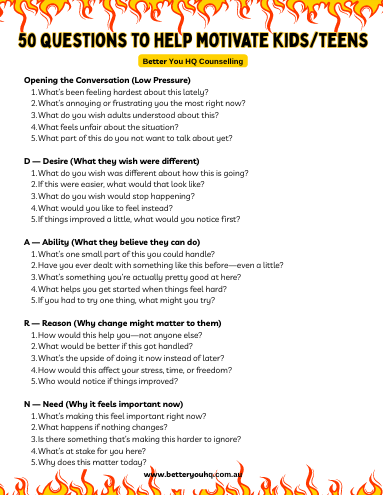
The Answer? The “50 Questions” Guide
Parents often ask me:
“What do I say instead of telling them what to do?”
These questions are drawn directly from counselling approaches like motivational interviewing and CBT.
They’re designed to help children:
feel heard without being interrogated
clarify what’s actually hard
identify small, achievable steps
reconnect with their own motivation
build confidence in their thinking
They’re organised to move gently from low-pressure reflection, through readiness and strengths, and towards next steps — the same way a counselling conversation naturally unfolds.
What This Can Look Like at Home
Instead of “Just get it done.”
You might ask, “What feels hardest about this right now?” “If this were a little easier, what would be different?” “What’s one small part you could handle first?”
These aren’t magic questions. They’re skill-building questions.
They teach children how to pause, reflect, and problem-solve — skills that support emotional regulation far beyond homework time.
When Extra Support Can Help
For some children, especially those experiencing anxiety, emotional regulation difficulties, or executive functioning challenges, these skills need more than quick prompts at home.
In counselling, we work at the child’s pace, helping them feel safe enough to think, reflect, and practise new strategies. Parents are supported too, so home becomes a place where skills are reinforced — not fought over.
Counselling isn’t about fixing kids. It’s about equipping them.
Start With the Questions
If you’re feeling stuck in power struggles, shutdowns, or daily overwhelm, this is a gentle place to start. A practical, counsellor-informed tool to reduce resistance and build problem-solving skills.
Sometimes the most powerful shift isn’t changing your child. It’s changing the conversation.
Download below: It's free, and NO email is needed!
About Prue and Better You HQ Therapy and Counselling Clinic
Prue is an ACA registered and qualified child and family counsellor with a passion for helping children, parents and adults navigate emotional challenges. As the founder of Better You HQ Therapy and Counselling Clinic, she specialises in supporting neurodivergent children, anxiety, emotional regulation, and social-emotional development. With experience in education and a deep understanding of childhood mental health, Prue offers evidence-based, compassionate support to families.
Better You HQ provides in-person counselling in Mansfield, Victoria, and online services Australia-wide, including assessments, emotion coaching, and parent support. Prue believes that emotional skills can be taught and that every child deserves a roadmap to thrive.


